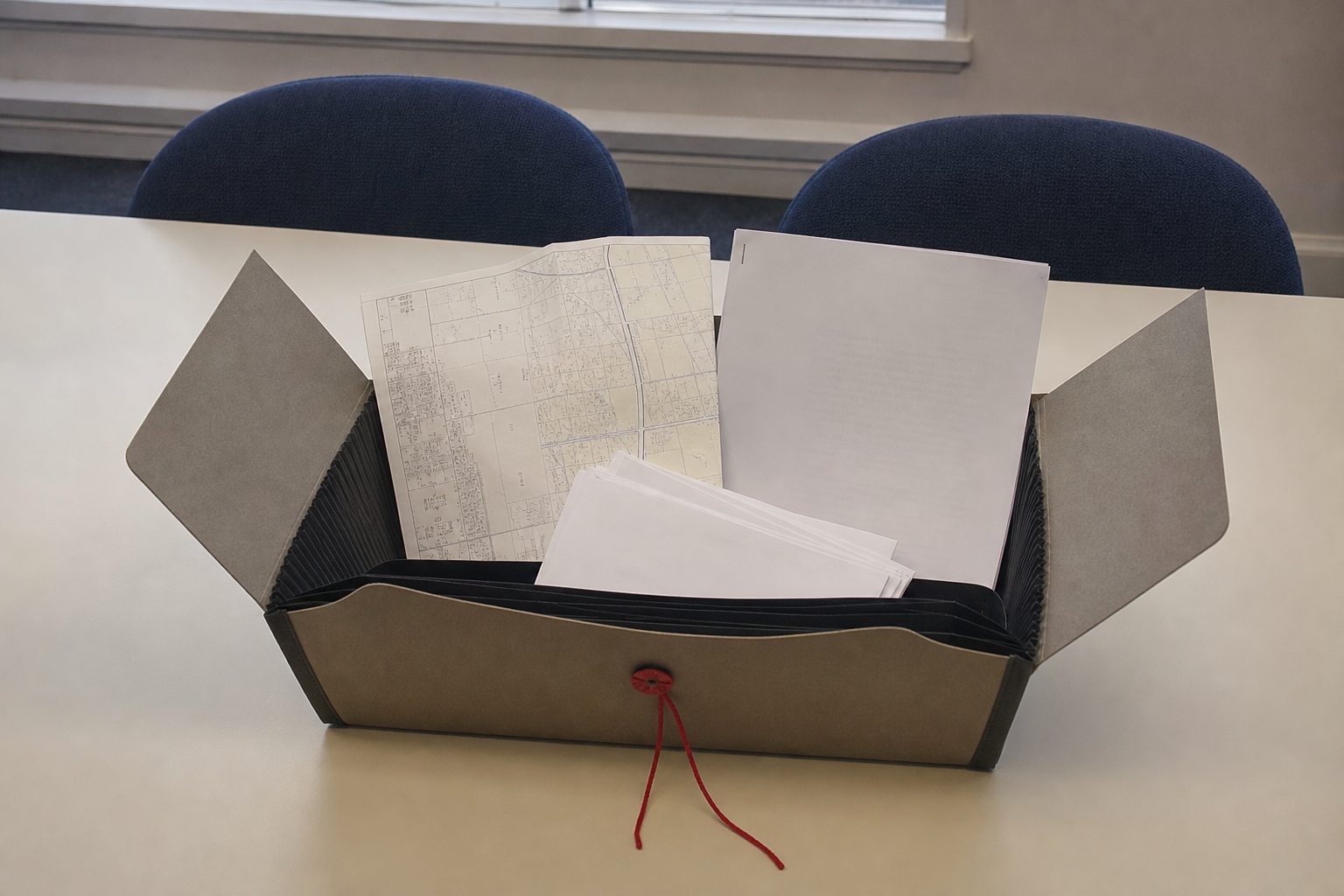
Application intake, fee receipt, and the certified property owner list
Every rezoning request begins when an applicant submits a formal application to the clerk's office. This package usually includes a completed form, a legal description of the property, and a site plan or map. The clerk's first job is to review the submission for completeness. If it is missing any required documents or signatures, the clock does not start until everything is in hand.
Most towns require a filing fee at intake. The receipt for this payment is the first document in the official file. It proves the applicant met the financial obligation and provides a paper trail for auditors.
The next step is one of the most technical: preparing the certified list of property owners. This list identifies everyone who owns land within a certain distance of the rezoning site, typically based on tax parcel maps or assessor's data. The clerk certifies this list, often by notarizing it or attaching a sworn statement, because it will determine who receives mailed notice later in the process.
Keep reading: Web Accessibility and Hybrid Meeting Rules Arriving by 2027
Referral to the planning commission and its recommendation
Once the application is complete, the clerk routes it to the planning commission or similar advisory board. This referral is formalized with a dated memo or cover sheet, which becomes part of the record. It ensures that the commission receives the same documents the council will see.
The planning commission reviews the materials and holds its own public meeting. The clerk or a staff designee records the minutes of this meeting. These minutes summarize the commission's discussion, any public comments, and the final recommendation, approval, denial, or approval with conditions.
That recommendation is documented in a signed letter or a certified copy of the commission's motion. This document is returned to the clerk's file. If the recommendation includes conditions, these must be spelled out clearly, as the governing body will later reference them when drafting the ordinance.
Published notice, mailed notices, and the posted sign affidavit
Legal notice publication
State statutes and local ordinances require public notice before a rezoning hearing. The clerk arranges for a notice to be published in a newspaper of record. This notice must include the date, time, and location of the hearing, the property address, and a summary of the requested action. After publication, the newspaper provides an affidavit of publication or a proof of publication, which is filed with the case.
Mailed notice to property owners
The certified owner list prepared earlier comes into play here. The clerk uses it to mail notices to each property owner within the specified radius. These notices are often sent by first-class mail, but some jurisdictions require certified mail or another trackable method. The clerk keeps a copy of the notice, a list of the addresses mailed, and receipts or a certificate of mailing. If a notice is returned as undeliverable, it is also added to the file to show the attempt was made.
Posting the property
Most towns require a physical sign to be posted on the subject property. The sign must be up for a certain number of days before the hearing, and its wording and location are regulated. The clerk or another staff member fills out an affidavit of posting, a sworn statement that the sign was erected as required. This affidavit, sometimes accompanied by a photograph, is added to the file.
Keep reading: Retention Checklist for Minutes, Recordings, and Packets
The hearing record: exhibits, sworn testimony, and the staff report
Compiling the agenda packet
Before the hearing, the clerk assembles the agenda packet for the governing body. This packet includes the application, planning commission recommendation, staff report, notices, affidavits, and any correspondence received. The packet is published or made available to the public, depending on local practice. A table of contents or index may be created to help navigate the documents.
Exhibits and public comment
During the public hearing, any documents presented become part of the official record. These can include maps, photographs, petitions, or letters from neighbors. The clerk keeps a log of each exhibit, assigns it a label, and ensures it is preserved. Oral testimony is recorded in minutes or by audio, but some towns require speakers to fill out a sign-in sheet or submit written comments, which are also filed as exhibits.
Staff report and recommendations
The staff report is a key document. It summarizes the application, analyzes compliance with zoning policies, and makes a recommendation. The report often addresses issues like traffic, infrastructure, or consistency with the comprehensive plan. The clerk certifies that the governing body received this report in advance of the hearing.
Findings of fact and how they differ from ordinary minutes
After the hearing closes, the governing body must make findings of fact to support its decision. Unlike regular meeting minutes, which summarize discussion and record votes, findings of fact are a legal narrative. They state which evidence was considered, which standards were applied, and how the facts support approval or denial.
These findings are usually drafted by staff but must be adopted by the council as a separate document or incorporated into the ordinance. The clerk's responsibility is to ensure the findings are specific, reference the evidence presented, and are included in the final record. If the decision is challenged, the court will look first to these findings to determine whether the body followed the law.
Ordinary minutes might simply note, "Motion approved to rezone as requested." Findings of fact, on the other hand, explain why the body acted as it did, including reference to public testimony, staff analysis, and any conditions imposed. The clerk certifies these findings as accurate and complete.
See how GavelMinutes handles this for local government
Ordinance adoption, effective date, and codification
Drafting and approving the ordinance
The outcome of a rezoning is enacted by ordinance. The clerk prepares the draft or reviews a draft from staff or counsel. The ordinance recites the findings of fact, legal description, zoning change, and any conditions attached. A draft is circulated before the meeting for review.
At the meeting, the ordinance is read and voted on according to local procedures. Some towns require two readings at separate meetings. The clerk records the roll call vote and finalizes the text as adopted, adding the signatures of the mayor and attesting official.
Publishing and effective date
State law often requires the adopted ordinance to be published in a newspaper or on the town website. The clerk files a proof of publication or certification of posting. The effective date is either specified in the ordinance or set by statute, such as ten days after publication. The clerk enters this date on the signed ordinance and notifies interested parties.
Codification
Once effective, the new zoning designation must be reflected in the town's official zoning map and code. The clerk updates the code or transmits the ordinance to a codifier. An updated map, showing the new zoning boundary, is prepared and certified. Both the ordinance and the map update become permanent records.
Assembling the return of record when the decision is appealed
If a rezoning decision is challenged in court, the clerk is responsible for assembling the return of record. This is the complete file that documents every step from application to ordinance. The court relies on this file to determine whether the process was fair and the decision supported by evidence.
The record includes: the application and fee receipt, certified property owner list, notices and affidavits, planning commission recommendation, agenda packets, exhibits, sign-in sheets, audio or transcript of the hearing, minutes, findings of fact, the adopted ordinance, and proof of publication. Each document is indexed and paginated. The clerk certifies the record as complete and submits it to the court by the required deadline.
Missing or incomplete records can jeopardize the town's defense. For this reason, clerks use standardized checklists and templates to ensure every required document is present. Increasingly, towns are turning to digital tools to manage these records. These systems can publish plain language summaries of each decision, link agenda items to supporting documents, and make the full record searchable for both staff and the public. This reduces error, saves time, and ensures transparency throughout the rezoning process.